
Cyprus
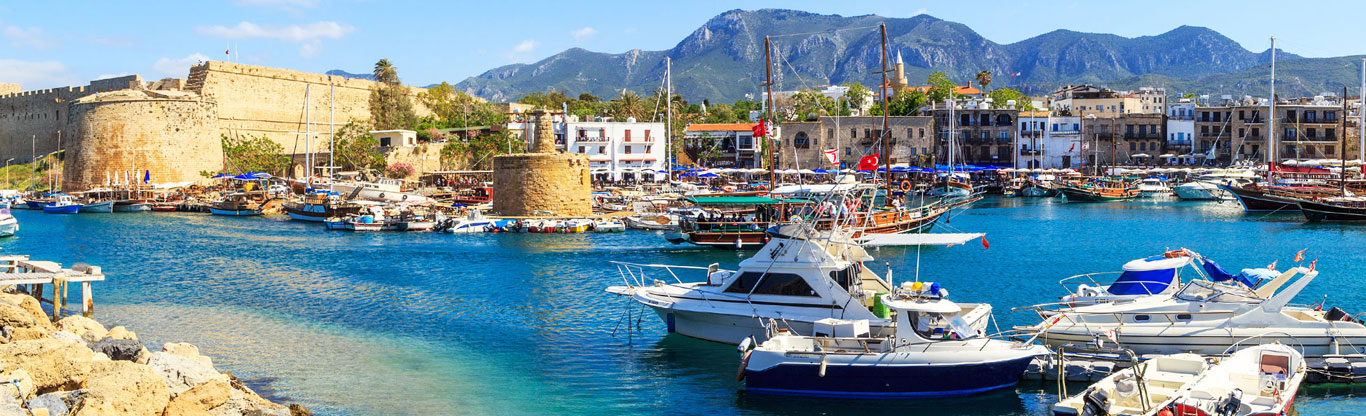
Today, Cyprus is a stable, economically advanced member of the European Union and provides a fascinating view of westernized cities and ultra-modern beach resorts residing side-by-side with traditional mountain villages and monasteries. It is quickly becoming a center for education and research in the region, with continuous incoming investment from international organizations and educational institutions.
An Island For All Seasons
- Cyprus is truly an “island for all seasons”. With over 300 days of sunlight annually, four distinct seasons and a mild climate, it is an ideal year-round destination. Every year, over 2.5 million tourists choose Cyprus as their vacation destination and many Europeans invest in second homes on the beautiful beaches and mountains of Cyprus.
- Cyprus offers a remarkably diverse natural and cultural environment for such a small country. In the same month, you can visit snow-tipped pine forests in the Troodos mountains, drive through fields of olive trees and relax by the clear blue Mediterranean sea.
- The cultural heritage of Cyprus mirrors its physical diversity. Ancient Greek temples, Roman amphitheaters, pre-historic settlements, Crusader castles, Venetian fortifications and Byzantine churches can all be found within a day’s drive of each other. Today, Cyprus retains a multi-cultural heritage combining Greek, Turkish and British influences in a modern European society.
Why Cyprus
- Low Costs: Costs are much lower compared to that in the USA and the UK.
- Visa Guarantee: Entry visas are issued in advance, so getting a visa is a not a problem as far as studying in Cyprus is concerned.
- Competitive European Standard of Education: The level of education and infrastructure facilities match those of the UK.
- Safe Environment and friendly atmosphere: The country is free from communal and political disturbances and hence provides students with a safe environment for learning.
- Attractive Places to Visit: Cyprus offers archaeological sites, resorts and exotic sea beaches that students can visit.
- International Community: Students from all over the world come to study in Cyprus.
Cyprus is a beautiful island in the northeastern basin of the Mediterranean Sea, at the crossroads of Europe, Asia and Africa. The island covers an area of 9,251 sq.km. with a population of 740,000, and is the third largest island in the Mediterranean. The island has superb mountain scenery, forests, fascinating coastlines and beaches, fertile plains, and a rich historical and archaeological heritage. The country’s economy is booming and over the last few years, Cyprus has emerged as one of the leading business and financial centres in the region.
Various sectors of the economy like tourism, banking, insurance and telecommunications provide the economy with a leading edge. ClimateCyprus enjoys a wonderful Mediterranean climate with long dry summers from mid-May to mid-October. The marvelous climate of the island offers endless opportunities to nature lovers. The language of the Greek Cypriot community is Greek while the language of the Turkish Cypriot community is Turkish. The national language is Greek, but English is spoken everywhere and it is the medium of instruction in the universities and colleges. The monetary unit (currency) in Cyprus is Cyprus Pound
Admission
Admission is subject to the availability of vacancies, provided there are no SC/SPR children on the schools’ waiting lists, and the schools’ admission criteria.
- International students without DP, IEO and whose parents are not SC/SPR and who are seeking admission to Primary 2-5 or Secondary 1-3 are required to sit for and pass a Qualifying Test (QT) before making a direct application to schools. International students seeking admission to Primary 1 or JCs are not required to sit for the QT; please see Step 2.
- Submit your application at the school of your choice with the required documents.
- If there is a vacancy, you will need to pass a placement test conducted by the school. Applicants will be tested on subjects such as English, Mathematics and Mother Tongue Language (where applicable).
- Upon passing the test, the school will issue you with a Letter of Acceptance (LOA). The Letter of Acceptance is valid for two weeks, during which time, you must apply for a Student’s Pass with the Immigration & Checkpoints Authority (ICA).
- The applicant must return to the school with a valid student’s pass within 2 weeks of the LOA’s date of issue. Otherwise, the applicant will forfeit his / her admission to the school.
For other private, foreign system, international schools and universities, polytechnics or institute of technical education:
- Apply directly to the educational institutions accompanied by the relevant certification and documentation.
- Some institutions or courses may require you to undergo an interview or placement test. Some schools may also require work experience.
Cost of Education
According to the results of the Cypriot government’s Household Budget Survey 2004, average monthly outgoings for a single person were at this time CY£647 (€1,105.47), for a couple CY£970 (€1,657.34) and for a couple with two children, CY£1,358 (€2,320.28). A couple owning their home could live fairly comfortably on a net income of between CY£6,000 (€10,251.61) and CY£7,000 (€11,960.21) per year (many pensioners lived on less).
Food is cheaper than in most northern European countries and around €430 will feed two adults for a month, including (inexpensive) wine, but excluding luxuries like fillet steak, caviar and imported delicacies. Local wines and spirits are good value and eating out is affordable, a meal for two averaging €40
Applying for a visa
Nationals of countries where an Embassy / High Commission / Consulate of the Republic of Cyprus is available in residency should submit to the Admission Office of the chosen educational institution the following documents in order to obtain, on their behalf, a preliminary approval for them to be interviewed at the Embassy/ High Commission/ Consulate of the Republicof Cyprus, in their home country:
- A fully completed application form.
- An application fee of 15-30 Cyprus Pounds (non-refundable).
- Four (4) passport-size photographs.
- Attested (certified true) copies of the student’s academic qualifications.
- Evidence of proficiency in English (if possible)
- A photocopy of their passport. The passport should be valid for at least one (1) year from the date of the student’s arrival.
The Admission Office will communicate details about the interview dates and required documents to candidates in time for the interview. During the visa interview at the Embassy/ High Commission/ Consulate of the Republic of Cyprus, the candidate must present:
- Original academic qualifications and their attested copies in English or in English translation.
- Their passport which should be valid for at least one (1) year from the date of their arrival to Cyprus
- A recent certificate of good conduct issued by the police of the country of origin or residence. The good conduct certificate should be original and be issued less than six (6) months prior to the beginning of the semester for which the student is applying. The names and titles of the persons issuing and certifying the document should be clearly stated therein. If not in English, official translation must also be presented.
- A recent financial guarantee issued by the student sponsor’s bank stating that the specific costs of living and studying in Cyprus (i.e. living expenses and the tuition fees) for one academic year at the educational institution will be met by the sponsor. The name of the sponsor and that of the student should be stated on the guarantee. The bank guarantee should be original and be issued less than six (6) months before the beginning of the semester for which the student is applying. The bank guarantee should include the mailing address, telephone number, fax number and e-mail address of the bank. If not available in English, official translation of the bank guarantee must be also submitted.
- Any other required documents (as advised by the educational institution).
Work After studies
Cyprus is currently in need of more lawyers, real estate experts and agents and marketers and business investors. The recent discovery of oil in the country has spurred the need for more working hands as well. The economy still runs on a free market structure and there is a need of a more delineated structure between private and government sectors. Workers in Cyprus generally earn around 5,000 euro a month but the country is aiming to double the amount in the near future.
Employment rate in Cyprus has grown at over 5% in the last three years. Only 4.7% of the total population is unemployed. The government is aiming to educate all younger generations to ensure future skilled workers in order to accommodate the presently lacking workforce. Expatriates will not have a problem finding a good-paying job in Cyprus especially if their expertise covers one of the fields currently in demand.
Universities
- Dogu Akdeniz Üniversitesi
- University of Cyprus
- University of Nicosia
- Cyprus International University
- Yakin Dogu Üniversitesi
- Cyprus University of Technology
- Girne Amerikan Üniversitesi
- Cyprus International Institute of Management
- European University Cyprus
- Frederick University
- Lefke Avrupa Üniversitesi
- Orta Dogu Teknik Universitesi Kuzey Kibris Kampusu
- Neapolis University
- University of Central Lancashire, Cyprus
- Alexander College
- American College
- Girne Üniversitesi
- The CTL Eurocollege
- Akdeniz Karpaz Üniversitesi
- College of Tourism and Hotel Management